
The Subtle Differences of Williamsburg Whites
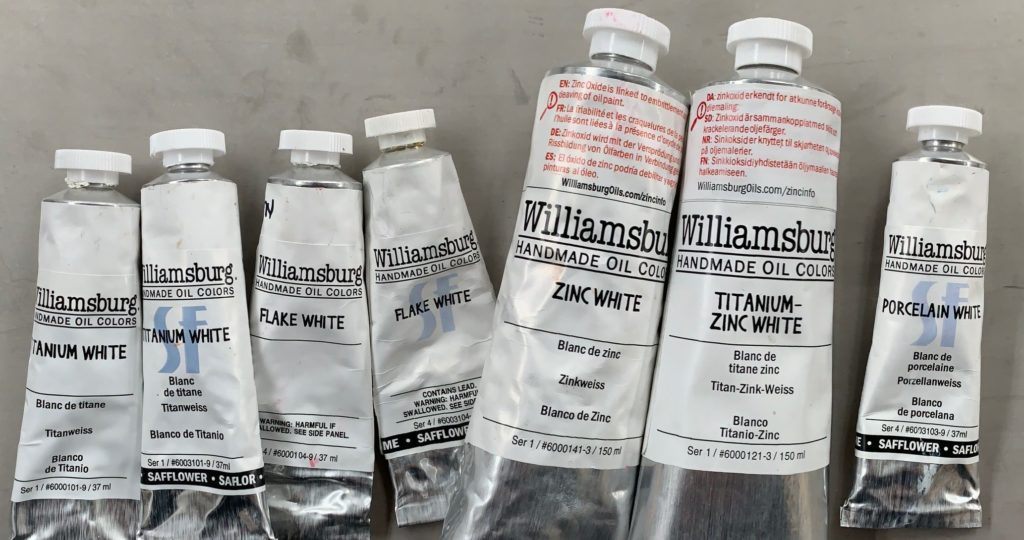
White is often thought to be as much as 20% of a typical painting. Used for grounds, for opacifying, for lightening or brightening deep colors, its importance cannot be overlooked. Not only is it a critical component coloristically, but understanding the whites in your oil painting will also aid the structural integrity of your painting. We thought it might be valuable to share an overview of the many whites that are on the palette of Williamsburg Oils.
Williamsburg has seven whites to choose from, including four linseed oil and three safflower oil-based whites. Among them are Titanium White, traditional Flake White, and a safflower oil-based white called Porcelain White, made with a lesser known pigment called Lithopone. This article will look at all seven of these whites and their functional characteristics of tinting strength, color temperature and feel.

Titanium White – PW 6 Titanium Dioxide Rutile pigment, Opaque, Fast drying 1-2 days, Lightfastness I
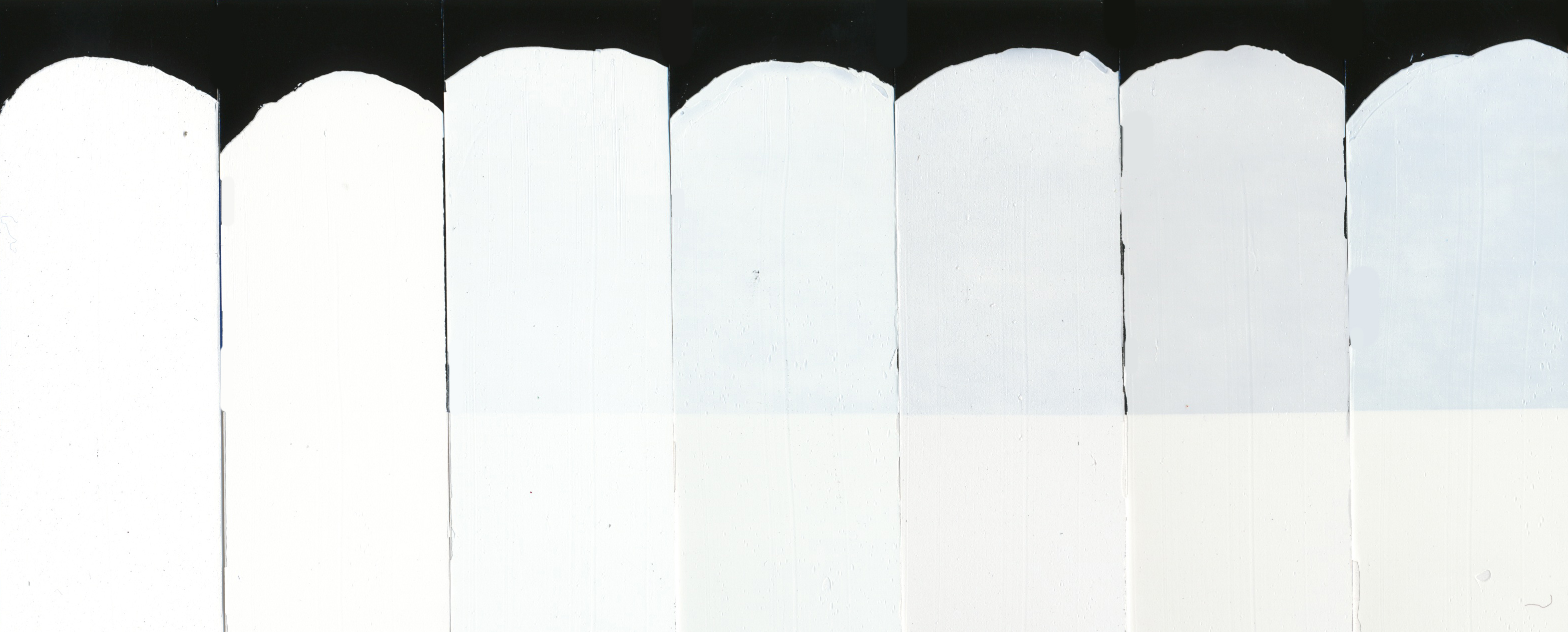
Williamsburg Titanium White is made with an alkali refined linseed oil binder. Our most popular white, Titanium has a buttery feel and a bright white color that is slightly warm when squeezed from tube. It has very strong tinting strength, which when added in higher ratios can cause color mixtures to become milky or creamy looking and in extreme cases, washed out. While a strong tinting strength is not a negative attribute, it does affect how much white can be added to a mixture if there is a desire for strong color saturation. Titanium will add opacity when combined with other colors. A very versatile white, it can be used for underpainting, alla prima works or in the medium rich, upper layers of a painting. We use Titanium Dioxide pigment (rutile) in all of our Williamsburg blends that contain white.

SF Titanium White – PW 6 Titanium Dioxide Rutile pigment, Opaque, Medium drying 2-7 days, Lightfastness I
Williamsburg safflower oil-based colors are designated with a light blue, translucent “SF” behind the color name on the label and a “SF” before the name on the color chart. These colors also have a black ring around the label stating that they are a safflower oil-based color. Colors ground in safflower oil are known to yellow less over the long-term than linseed oil-based colors. SF Titanium White is noticeably brighter and slightly cooler than our linseed oil Titanium when squeezed from the tube. While similar in feel and tinting strength to its linseed counterpart, it should be noted that safflower oil is a less durable binder than linseed oil. This means it is best used thinly and/or in the upper layers of a painting where its bright white color will be most appreciated. One of the main reasons to use this color is to make white passages or high key mixtures in the upper layers where a bright white will be most noticeable and where less yellowing is desired.
HERE is a link to additional information about Williamsburg safflower oil-based colors.

Flake White – PW 1 Basic Lead Carbonate pigment, Semi-Opaque, Medium drying 2-7 days, Lightfastness I
Flake White is our most dense white. Made with linseed oil, it has a warm color quality that is off-white from the tube and provides a sun soaked, natural warmth to color mixtures. It has a medium to low tinting strength, which allows mixtures to maintain their color identity without washing them out. The benefit of having less tinting strength in a white, is that larger quantities of mixed color can be made that contain more white than color, but still have good chroma. In many cases, this can provide a cost savings, but also, Flake White has good drying qualities and aging properties that it will lend to any mixture. Flake White produces a hard but flexible film and can contribute durability to an oil painting. Flake is an excellent general purpose white. It’s a great choice for the initial layers of an extended painting. It can also be used for underpainting, grisaille or for color mixing in the upper layers. Flake’s semi-opacity and moderate tinting strength is especially nice when applying finishing touches where colorful mixtures really need to sing.
Note on lead toxicity – lead can enter body through ingestion, inhalation of pigment particles and through broken skin. This product is safe when used as intended by professional artists. Paintings containing Flake White should not be sanded.

SF Flake White – PW 1 Basic Lead Carbonate pigment, Semi-Opaque, Medium drying 2-7 days, Lightfastness I
SF Flake White is similar in working properties to its linseed oil-based counterpart. SF Flake is slightly whiter from the tube and mixes cooler, less yellow colors than linseed oil-based Flake. As mentioned above, colors made with safflower oil should yellow less over the long-term, and are better used thinly and in the upper layers of a work. To build up a painting with many layers, we recommend starting with linseed oil – based colors for a more durable base, and then transition to SF colors in the upper layers to have less yellowing whites and color mixtures.

Zinc White – PW 4 Zinc Oxide pigment, Semi-Opaque, Very slowly drying 10-21 days, Lightfastness I
Zinc White is our most translucent white with a warmish color temperature when squeezed out of the tube. It has medium to low tinting strength, which allows colors to maintain maximum chroma even with significant Zinc additions. Thin applications of Zinc can be used to create translucent veils with or without the addition of medium. A major drawback of Zinc Oxide is its tendency toward embrittlement. This pigment dries to a very hard film that becomes brittle within a relatively short period of time. Mixtures that contain even a small percentage of Zinc White can become brittle within a year or two. It is recommended to use Zinc only on rigid supports, applied thinly in the upper layers of the painting. This color is only available ground in linseed oil in 150 ml tubes.
HERE is a link to additional information about Zinc Oxide and embrittlement.

Titanium-Zinc White – PW 6 Titanium Dioxide Rutile pigment, PW 4 Zinc Oxide pigment, Opaque, Medium drying 2-7 days, Lightfastness I
When mixed together, Titanium Dioxide and Zinc Oxide pigments have a chemical relationship that keeps them whiter together than either are able to maintain on their own. Out of the tube this paint is a slightly warm white, that feels and mixes like Titanium White. The main benefit of this blend is the continuing whiteness it is able to provide. The Zinc additions in this color make it vulnerable to embrittlement. For best results, this color should be used according to the Zinc White recommendations above. Titanium-Zinc White is only available ground in linseed oil in 150 ml tubes.

SF Porcelain – PW 5 Complex co-precipitate of Barium Sulfate and Zinc Sulfide pigment (also called Lithopone), Semi-Opaque, Medium drying 2-7 days, Lightfastness EX (equivalent to ASTM LF I)
Porcelain is a bright, cool white with a dense feel and a slightly stringy rheology. It has medium tinting strength roughly between Titanium White and Flake White. Porcelain White is great for most paint applications, especially for building thinner layers or alla prima works. Porcelain is ground in safflower oil, and is not available in linseed oil. It stays bright white over the years. The Zinc Sulfide component of this pigment is not the same as Zinc Oxide and does not show embrittlement in any of our testing. As a side note, early forms of Lithopone had the stigma of darkening when exposed to UV light, which made them unsuitable for exterior applications. A manufacturing improvement early in the 20th century remedied that flaw. Today’s Lithopone, including the pigment we use for our Porcelain White, is entirely stable in UV light and shows excellent lightfastness in all of our testing, including exterior exposure.
While it is possible to do without some colors, white is a critical color on the oil painting palette. What else can lighten the value of a color without removing it completely from its original hue family? The choice of white can set the temperature for an entire work or be used in tandem with another white to broaden the mixing potential of a palette. One possibility worth exploring would be reserving one white for the high key areas of a painting and using another for middle tones or creamy shadows. We hope this overview has piqued your interest enough to try a new white and experience for yourself the potential it can bring to your tints and color mixtures.
Additional Images:
For any questions of comments please contact help@goldenpaints.com or call 800-959-6543 (in USA only), 607-847-6154, or in Europe 0049 (0)69-348 72 154
Williamsburg Dry time chart: https://goldenhub.goldenpaints.com/storage/uploads/williamsburg-drytime-chart-091818.pdf
Williamsburg color chart: https://www.williamsburgoils.com/products/colors